If you have spent any time reading about AI this year, you have seen both terms thrown around as if they mean the same thing. They do not. The difference between agentic AI vs generative AI comes down to one word: authority.
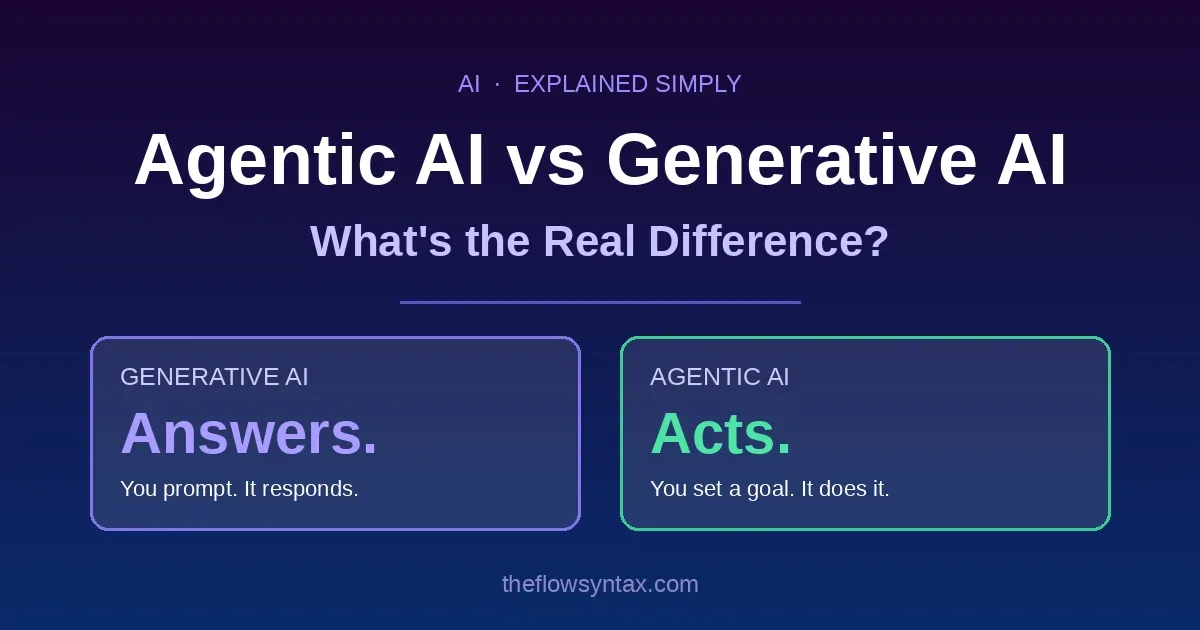
Generative AI answers you. Agentic AI acts for you.
That sounds like a small distinction. It is not. It changes what you can hand over, what can go wrong, and what you need to check. This guide explains the difference in plain language, shows you both working on the same task, and helps you work out which one you actually need.
The short answer
Generative AI produces something when you ask: text, an image, a block of code, a summary. You prompt, it responds, and the exchange ends there. Nothing happens next unless you make it happen.
Agentic AI is given a goal rather than a prompt. It breaks that goal into steps, decides the order, uses tools to carry them out, checks whether it worked, and adjusts if it did not. You are not in the loop for every step.
Here is the cleanest way to feel the difference.
Ask generative AI to 'write an email to customers about the delayed order' and you get an email. A good one, probably. Then you copy it, paste it into your mail client, pick the recipients, hit send, and watch for replies yourself.
Give an agent the goal 'tell affected customers about the delay and handle the replies' and it queries which orders are late, drafts the message, sends it, reads the responses, issues refunds where the policy allows, and escalates the three cases it is unsure about.
Same underlying model. Completely different amount of trust.
What is generative AI?
Generative AI learns patterns from an enormous amount of existing material, then produces new material that fits those patterns. Large language models do it with text. Diffusion models do it with images. The mechanics differ, but the shape is the same: input goes in, output comes out.
What it is genuinely good at
Anything where a human stays in the driver seat and wants a faster first draft. Writing and rewriting. Summarising a long document. Explaining a concept five different ways until one lands. Translating. Turning messy notes into a clean structure. Producing boilerplate code you were going to write anyway.
The common thread: you decide what to do with the output. The model has no idea whether you used it, ignored it, or laughed at it.
Where it stops
A generative model has no memory of your goal between requests, no ability to check its own work against reality, and no hands. It cannot look up your live inventory, click a button, or notice that the thing it suggested yesterday did not work.
It also does not know when it is wrong. It produces the most plausible-looking answer, and plausible is not the same as correct. That is fine when a human reads every word before acting on it. It becomes a real problem the moment nobody does.
What is agentic AI?
Agentic AI wraps a generative model in a loop that can actually do things. The model becomes the reasoning engine; the system around it supplies memory, tools, and a way to check results.
This is the part most explanations skip: agentic AI did not replace generative AI. It is built on top of it. Nearly every agent you will meet has a large language model at its core. The difference is everything bolted around that core.
The four things that make an agent an agent
A goal, not a prompt. You describe the outcome you want. The agent works out the steps. 'Find me three suppliers under budget who can ship by Friday' instead of 'write an email asking about shipping'.
Tools. An agent can call an API, search the web, query a database, run code, send a message. Without tools it is just a chatbot with extra steps.
Memory. It keeps track of what it has already tried, what worked, and what it learned along the way, so step seven benefits from step two.
A feedback loop. It checks its own output against reality. Did the code run? Did the API return an error? Did the customer reply? Then it adapts instead of ploughing ahead.
Take any one of those away and you do not have an agent. You have automation with a language model attached.
Agentic AI vs generative AI: side by side
| Generative AI | Agentic AI |
|---|
| You give it | A prompt | A goal |
| It gives you | Content | A completed task |
| Steps | One | Many, decided by the system |
| Uses tools | No | Yes — APIs, databases, code, the web |
| Memory | Usually just the current chat | Persists across the whole task |
| Checks its work | No | Yes, and retries |
| You are involved | Every single time | At the start, and when it escalates |
| Fails by | Being confidently wrong | Being confidently wrong and acting on it |
| Best for | Drafting, summarising, explaining | Multi-step work with a clear finish line |
That last row is the one worth sitting with. Both technologies make mistakes at roughly similar rates, because they run on the same models. The difference is what a mistake costs. A bad paragraph wastes a minute. A bad refund, sent automatically to four thousand customers, is a different kind of morning.
The same task, two ways
Say a customer emails: 'My order never arrived and I want my money back.'
With generative AI, a support agent pastes the email in and asks for a reply. The model writes something warm and professional. The human checks the order number, confirms it really was lost, decides a refund is appropriate, processes it in the billing system, sends the reply, and sets a reminder to follow up. The AI saved maybe two minutes of writing.
With an agentic system, the goal is 'resolve this ticket'. The agent pulls the order, checks the courier tracking API, sees delivery failed, reads the refund policy, confirms the order qualifies, issues the refund through the billing system, writes the reply, sends it, and logs the resolution. If the order had been marked delivered, it would have flagged the ticket for a human instead of guessing.
The second version does the whole job. It also touched your billing system without asking, which is exactly why it needs limits, logging, and a clear rule about when to stop and ask.
AI agents examples you can see today
These are the categories where autonomous AI agents have moved past the demo stage.
Software development
Coding agents now take an issue, read the codebase, write the change, run the test suite, read the failures, and fix them before opening a pull request. The loop of write, run, read the error, try again is a near-perfect fit for agents, because the feedback is instant and unambiguous. Code either compiles or it does not.
Customer support
Agents handle the tickets that follow a policy: refunds within a window, address changes, subscription pauses, order status. The realistic setup is not full autonomy. It is an agent that closes the routine sixty per cent and hands the rest to a human with the context already gathered.
Research and analysis
Give an agent a question, and it searches, reads, cross-checks sources, notices contradictions, and searches again to resolve them. This is genuinely different from asking a chatbot, because the agent keeps going until it has an answer it can support rather than answering immediately from whatever it already knows.
Operations and back office
Reconciling invoices against purchase orders, chasing missing data, updating records across systems that were never designed to talk to each other. Unglamorous, rule-heavy, and exactly the work agents suit — clear inputs, checkable outputs, and a human who only wants to see the exceptions.
Where autonomous AI agents still fall short
It is worth being straight about this, because the marketing is well ahead of the reality.
Errors compound. A ten-step task where each step is 95% reliable finishes correctly about 60% of the time. Longer chains make it worse, fast. This is the single biggest reason agents look brilliant in demos and disappointing in production.
They do not know what they do not know. An agent that cannot find the answer will often invent a plausible one and keep going, because nothing in the loop tells it to stop.
Permissions are a real design problem. Anything an agent can touch, it can touch wrongly. Every serious deployment ends up spending more time on limits, approvals and audit logs than on the AI itself.
Adoption is early. In McKinsey 2025 global survey, 62% of organisations said they were experimenting with agentic systems — but only 23% had scaled any into production. That gap is the whole story of where this technology currently sits.
None of this means agents do not work. It means they work inside boundaries, on tasks where the result can be verified.
So which one do you actually need?
Reach for generative AI when a human is going to review the output anyway, the task is one step, the value is in speed of drafting, and being wrong costs almost nothing.
Reach for agentic AI when the task genuinely has multiple steps, those steps need real systems, the finish line is objectively checkable, and the same job repeats often enough to be worth building for.
A test that saves a lot of wasted effort: can you tell, automatically, whether the task succeeded? If yes, an agent has something to steer by. If success is a matter of taste or judgement, you want generative AI with a human deciding.
And if you are unsure, start with generative AI. It is cheaper, faster to set up, and it teaches you where the actual bottleneck is. Plenty of teams build an agent for a problem that a good prompt and a copy-paste already solved.
What this means going forward
The interesting shift is not that agents replace chatbots. It is that the unit of work changes. Today you ask AI for a paragraph and assemble the result yourself. Increasingly you will describe an outcome and review what came back.
That makes reviewing a skill worth having. Knowing what a good result looks like, spotting where an agent quietly went off track, and deciding what it should never be allowed to touch — these matter more as the systems get more capable, not less.
The teams doing well with this are not the ones who handed over the most. They are the ones who were clearest about the boundary.
The takeaway
Generative AI creates. Agentic AI decides and does. Agents are built on generative models, so this was never a competition — it is a question of how much authority you are handing over, and whether you have set up a way to check the result.
Start with the smaller thing. Give an agent one repetitive, verifiable task. Watch it closely. Expand only when you trust what you are seeing.
Found this useful? I write practical guides on AI, web development and the tools that actually make it into real projects. Browse the full tutorials library — everything is free, and nothing is behind a sign-up.
Have a question about building with agents, or a use case you are not sure fits? Drop it in the comments below.
Loading comments...