Introduction to PHP for Beginners
PHP is one of the easiest and most popular languages for building dynamic websites, which makes it a perfect starting point if you're learning PHP for beginners. In this first lesson you'll learn what PHP is, what you can build with it, how it runs on a server, and you'll write your very first PHP script.What is PHP?
PHP (a recursive acronym for "PHP: Hypertext Preprocessor") is a free, open-source, server-side scripting language. "Server-side" means the code runs on the web server — not in the visitor's browser — and produces plain HTML that gets sent to the browser. PHP powers a huge part of the web, including WordPress and frameworks like Laravel.
What can you build with PHP?
- Dynamic websites and blogs
- Login systems and user dashboards
- E-commerce stores and REST APIs
- Anything that talks to a database (usually MySQL)
How PHP works (server-side)
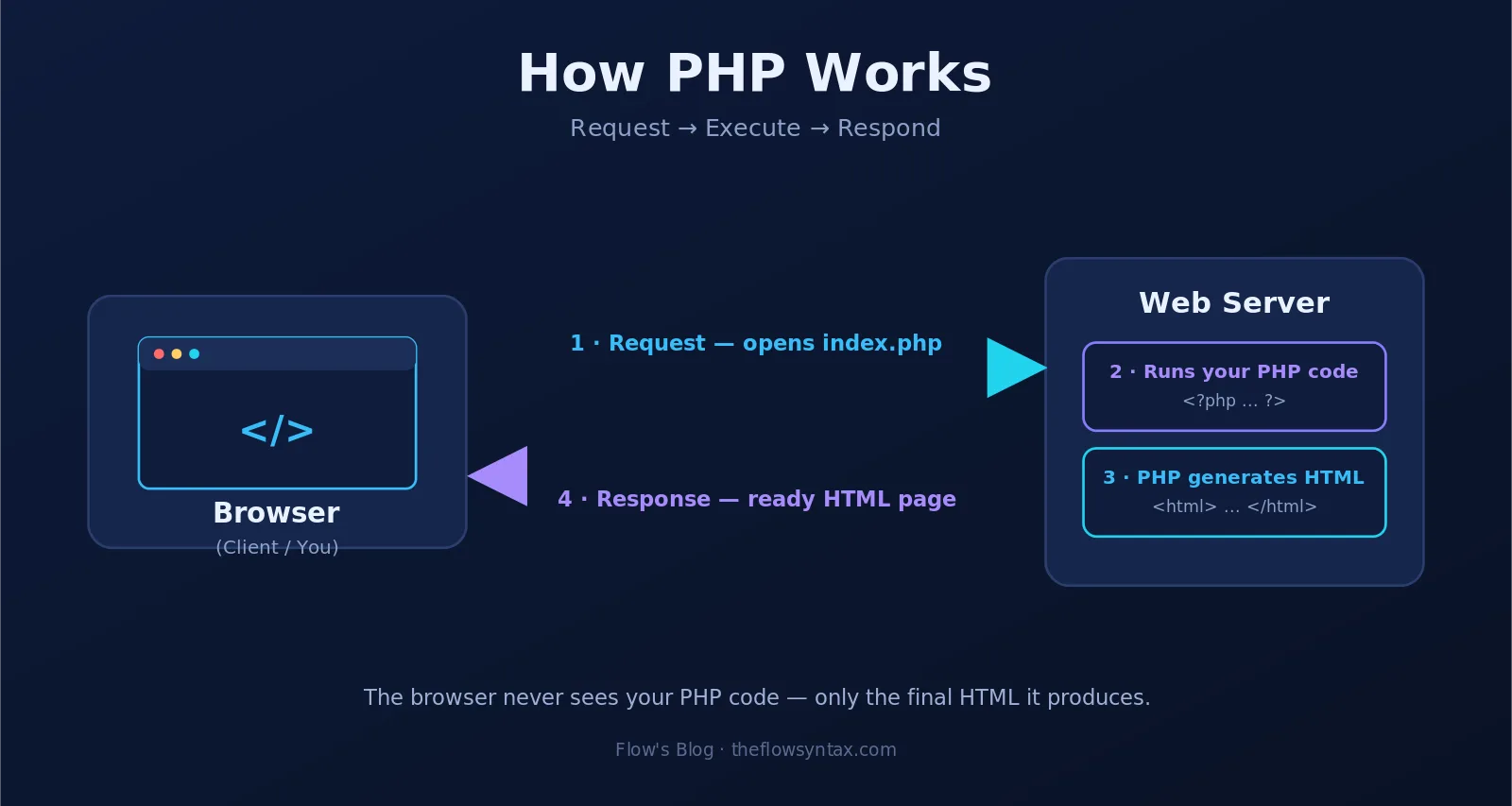
When a visitor opens a .php page:
- The browser requests the page from the server.
- The server runs your PHP code.
- PHP produces plain HTML.
- The server sends that HTML back to the browser.
The visitor never sees your PHP code — only the final result.
Your first PHP script
Create a file called index.php:
<?php
  echo "Hello, World!";
?>
Open it in your browser through a PHP server and you'll see Hello, World!
- <?php ... ?> tells the server "this part is PHP".
- echo outputs text to the page.
What you need to start
- A local server: XAMPP (Windows) or MAMP (Mac) — both include PHP + MySQL.
- A code editor like VS Code or PhpStorm.
What's next
In the next lesson, PHP Basics, you'll learn PHP syntax, variables, and data types — then we'll move on to OOP, forms, and connecting to MySQL.
That's the big picture. Throughout this PHP for beginners series you'll move from these basics to building real, database-driven web pages, one step at a time.
Common questions about learning PHP
A few things people always ask before they write their first line of PHP.
Is PHP still worth learning?
Yes. PHP runs a very large share of the web, including WordPress, and Laravel keeps it current for new projects. It is also one of the easiest server-side languages to see working on day one, which matters when you are starting.
Is PHP hard to learn for a complete beginner?
It is one of the gentler starting points. You do not declare types, you do not compile anything, and you can see a result in the browser within minutes. The parts that take longer — arrays, objects, databases — come after the basics are comfortable.
Do I need to know HTML before learning PHP?
It helps but it is not required on day one. PHP produces HTML, so you will pick up the basics as you go. If you can save a file and open a folder, you can start.
What software do I need to start writing PHP?
A local server such as XAMPP or MAMP, which gives you PHP and MySQL together, plus a code editor like VS Code. All of it is free and nothing needs hosting.
Loading comments...